arXiv: 2604.22234 · PDF
Authors: Taizun Jafri, Vidya A. Chhabria
Affiliations: Arizona State University
Primary category: cs.AR · all: cs.AR
Matched keywords: large language model, llm, agent, agentic, rag
TL;DR
GR-Evolve is an agentic LLM framework that iteratively rewrites global-routing source code per design, using QoR-driven feedback in OpenROAD to produce design-adaptive EDA tooling. Across seven benchmarks on three technology nodes, it cuts post-detailed-routing wirelength by up to 8.72% over baseline routers.
Key Ideas
- Introduces design-adaptive EDA tooling: specialize internal tool algorithms per design rather than tuning hyperparameters on fixed heuristics.
- Instantiates the paradigm with GR-Evolve, an LLM-driven code evolution framework for global routing.
- Uses QoR-driven iterative feedback with persistent contextual knowledge of open-source routers.
- Demonstrates LLM-authored algorithm changes can beat hand-tuned routers on real designs.
Approach
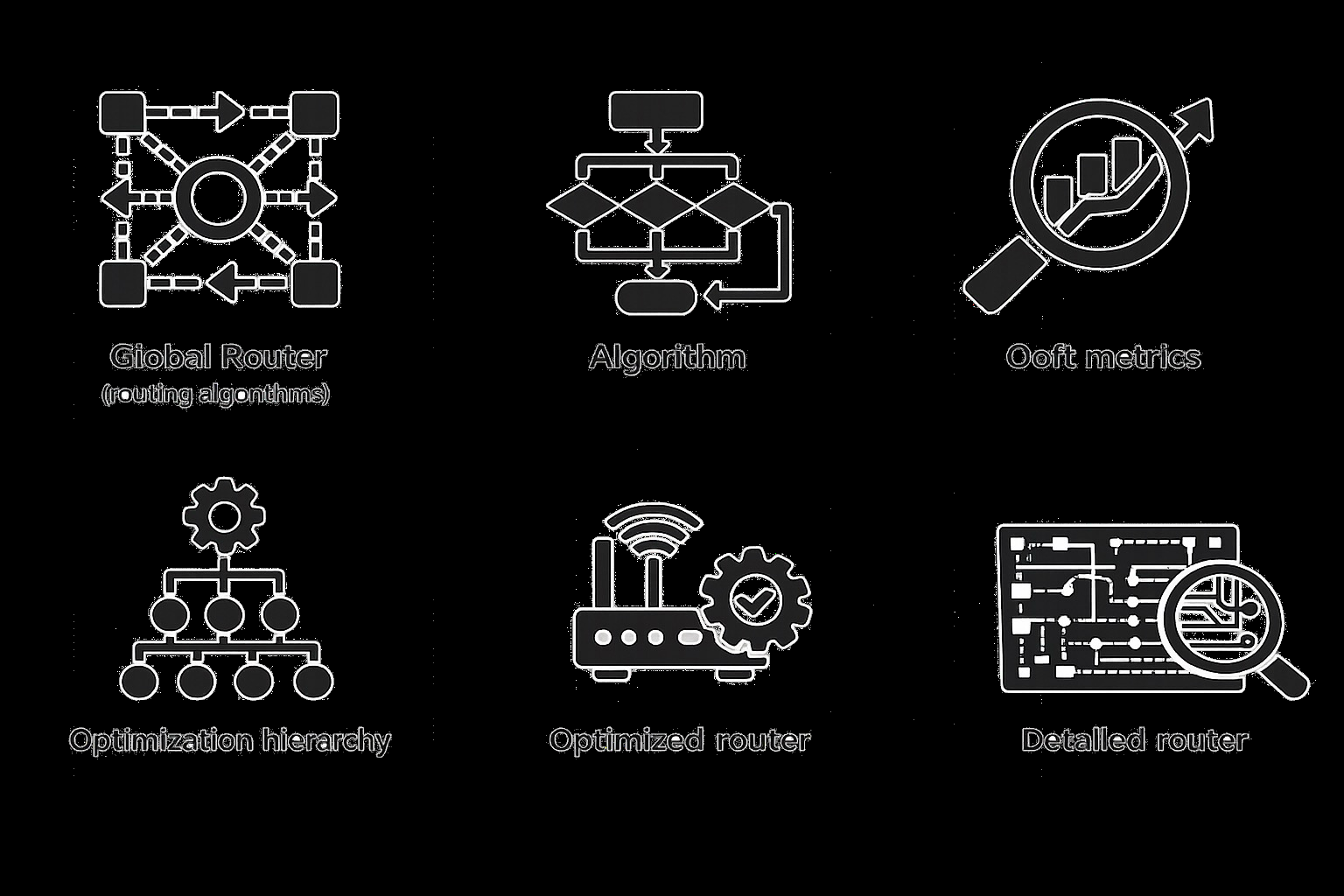
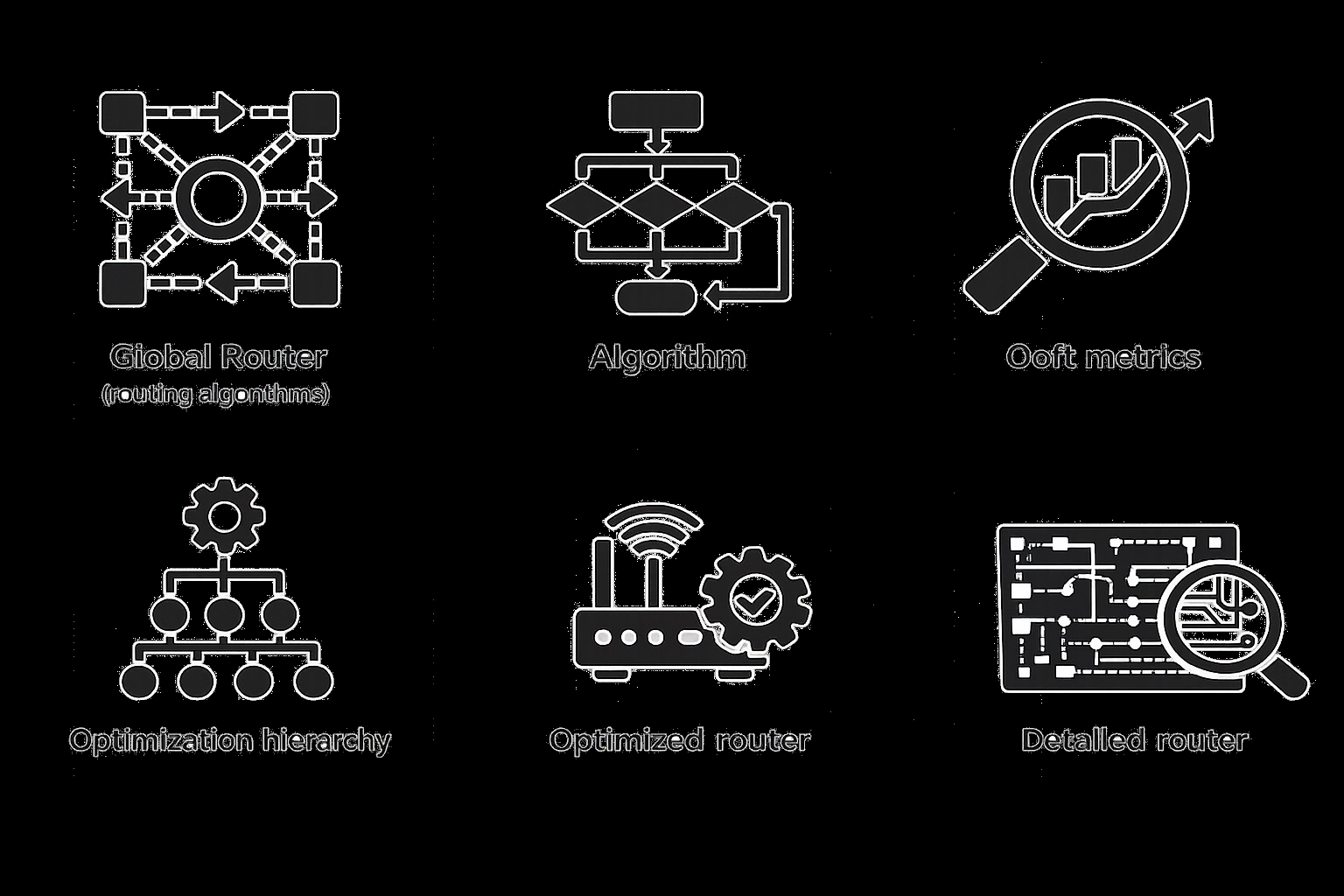
GR-Evolve wraps an agentic LLM around global-routing source code and iteratively mutates it. The agent is grounded with persistent contextual knowledge of open-source global routers and an integrated OpenROAD toolchain that evaluates each candidate’s QoR. Accumulated QoR history from prior iterations feeds back into the knowledge base to guide the next code-edit proposal, closing a design-adaptive evolutionary loop.

Experiments
Seven benchmark designs evaluated across three technology nodes, routed through the OpenROAD flow. Baselines are existing open-source global routers available in that infrastructure. Primary metric: post-detailed-routing wirelength (QoR), with iterative LLM-driven code edits compared against the unmodified baseline router.
Results
Up to 8.72% reduction in post-detailed-routing wirelength over baseline routers. The abstract reports only this headline number and does not break down per-design or per-node deltas, runtime cost, or convergence behaviour, so the magnitude of the average gain is unclear.
Why It Matters
Moves EDA beyond hyperparameter tuning toward LLMs that rewrite tool internals per design. If it generalizes, the same pattern could apply to placement, CTS, or timing optimization — turning static EDA binaries into design-specialized agents and shifting productivity bottlenecks in ASIC flows.
Connections to Prior Work
Builds on learning-based EDA optimization and design-specific hyperparameter tuning (e.g., autotuners over OpenROAD), but departs by mutating algorithms rather than knobs. Related to LLM-driven code evolution (FunSearch, AlphaEvolve-style loops) and agentic coding applied to a domain tool rather than general software.
Open Questions
- Average vs. best-case wirelength gain across the seven designs, and per-node variance.
- Compute/LLM cost per design and whether evolved routers generalize or must be re-evolved each time.
- Impact on congestion, DRC, runtime, and timing — not only wirelength.
- Robustness to larger industrial designs and non-OpenROAD flows.
- Safety / correctness guarantees when the LLM edits router source code.
Original abstract
Modern ASIC design is becoming increasingly complex, driving up design costs while limiting productivity gains from existing EDA tools. Despite decades of progress, current tools rely on fixed heuristics and offer limited control via tool hyperparameters, requiring extensive manual tuning to achieve an acceptable quality of results (QoR). While prior work has explored learning-based optimization and design-specific hyperparameter tuning, these approaches operate within the constraints of static tool algorithm implementations and do not adapt the underlying algorithms to individual designs. To address this limitation, we introduce the concept of design-adaptive EDA tooling, in which the internal algorithms of EDA tools are automatically specialized to the characteristics of a given design. We instantiate this paradigm through GR-Evolve, a code evolution framework that leverages an agentic large language model (LLM) to iteratively modify global routing source code using QoR-driven feedback. The framework equips the LLM with persistent contextual knowledge of open-source global routers along with an integrated toolchain for QoR evaluation within the OpenROAD infrastructure. We evaluate GR-Evolve across seven benchmark designs across three technology nodes and demonstrate up to 8.72% reduction in post-detailed-routing wirelength over existing baseline routers, highlighting the potential of LLM-driven EDA code evolution for design-adaptive global routing.