arXiv: 2604.22312 · PDF
作者: Long Cheng, Ritchie Zhao, Timmy Liu, Mindy Li, Xianjie Qiao, Kefeng Duan, Yu-Jung Chen, Xiaoming Chen, Bita Darvish Rouhani, June Yang
主分类: cs.DC · 全部: cs.AR, cs.DC, cs.PF
命中关键词: llm, rag, serving, speculative decoding, attention, latency
TL;DR
GVR 利用相邻 decode 步骤 Top-K 的时间相关性,在 Blackwell 上以 guess-verify-refine 三段式加速稀疏注意力的精确 Top-K 选择,单算子平均提速 1.88×。
核心观点
- Sparse-attention decoder 的 exact Top-K 阶段即使已高度优化,仍是长上下文 LLM serving 的显著延迟瓶颈。
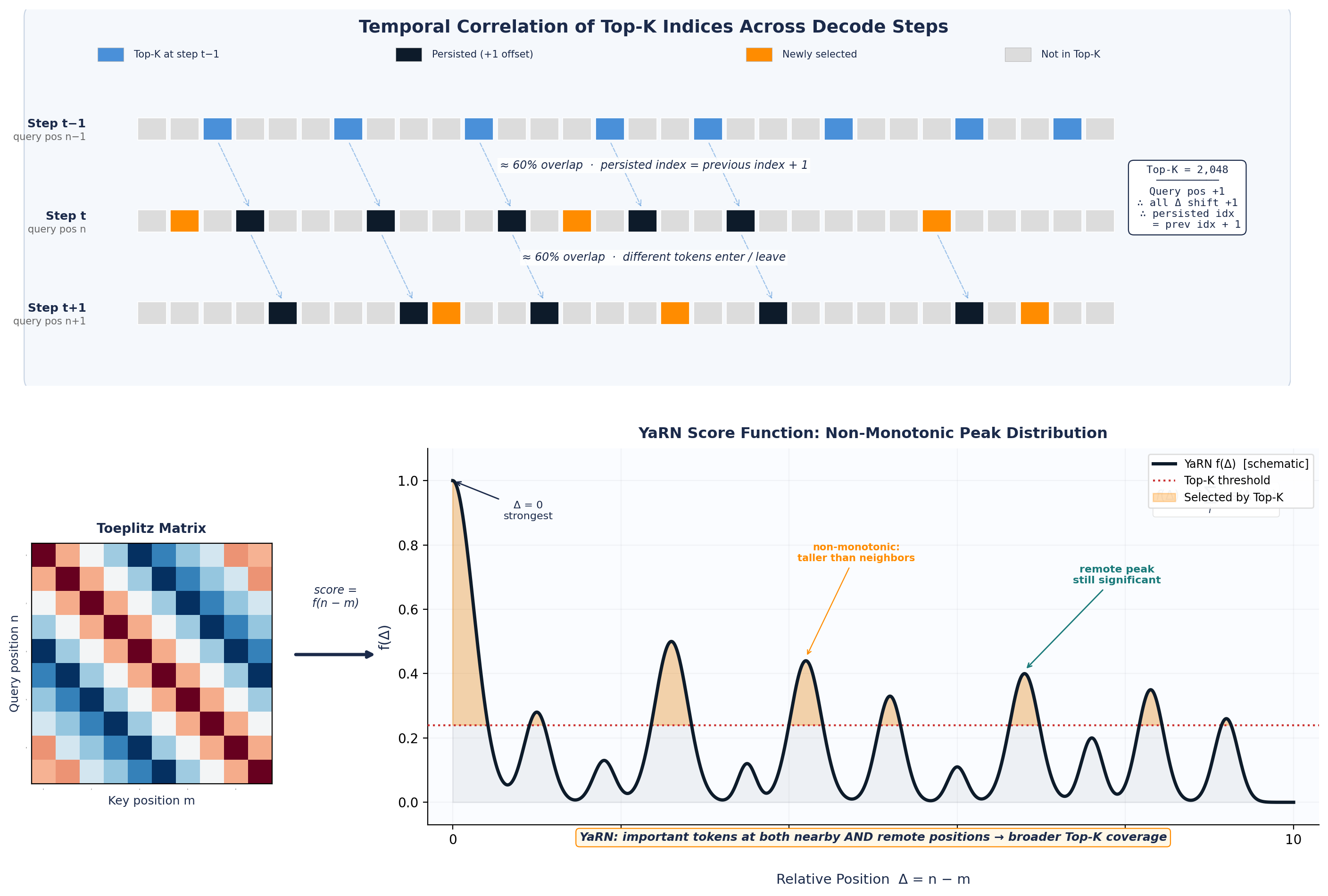
- 连续 decode step 之间 Top-K 集合具有强时间相关性,可用作先验预测信号。
- 将 DSA indexer 分数的 Toeplitz / RoPE 结构与 Top-K 稳定性联系起来,奠定数据感知设计基础。
- 提出 GVR 算法在保持 bit-exact 输出前提下显著快于生产级 radix-select kernel。
方法
GVR 分三步:(1) Guess —— 以上一 step 的 Top-K 作为预测,读取预先计算的统计量;(2) Verify —— 用 secant-style counting 在 1-2 次 global pass 中收敛到合法阈值,并通过 ballot-free collector 收集候选;(3) Refine —— 在 shared memory 中完成精确选择。整个流程针对 NVIDIA Blackwell 架构特性设计,并集成进 TensorRT-LLM 的 DSA 栈。
实验
- 工作负载:真实 DeepSeek-V3.2 + DSA indexer。
- 基线:TensorRT-LLM 生产级 radix-select Top-K kernel。
- 部署:TEP8 min-latency,100K context,含 speculative decoding 场景。
- 指标:单算子 speedup、端到端 TPOT、上下文长度伸缩性、bit-exact 正确性。
结果
单算子相对 radix-select 平均 1.88× 加速,峰值 2.42×/layer/step;100K context 下端到端 TPOT 最多改善 7.52%,上下文越长收益越大,speculative decoding 下收益缩小但仍为正。Top-K 输出保持 bit-exact。
为什么重要
对长上下文 LLM serving,Top-K 选择常被忽视却是隐形瓶颈。GVR 说明:利用跨 step 的时间相关性可把精确 Top-K 降为"验证+微调",为 sparse attention 推理栈提供一条不损精度的加速路径,对 DSA、Blackwell 部署尤其直接可用。
与已有工作的关系
- 建立在 DeepSeek Sparse Attention (DSA) 与 DeepSeek-V3.2 之上。
- 替换 TensorRT-LLM 中基于 radix-select 的 Top-K。
- 与 RoPE、Toeplitz 结构分析相关的注意力打分研究相呼应。
- 属于 sparse attention / KV 选择这一加速家族(如 H2O、Quest 等近似方法),但聚焦精确 Top-K。
尚未回答的问题
- 在非 DSA(如 learned indexer、非 RoPE 结构)上时间相关性假设是否仍成立。
- Prefill 阶段或 batch 大、请求差异强的场景适用性如何。
- 在 Hopper/消费级 GPU 或无 ballot-free 原语硬件上的可移植性。
- 与 speculative decoding、chunked prefill 等技术组合时收益衰减的根因及缓解。
- 预索引统计量的内存与维护开销在大规模部署下的具体代价。
论文图表
图 1: Figure 1 (extracted from PDF)
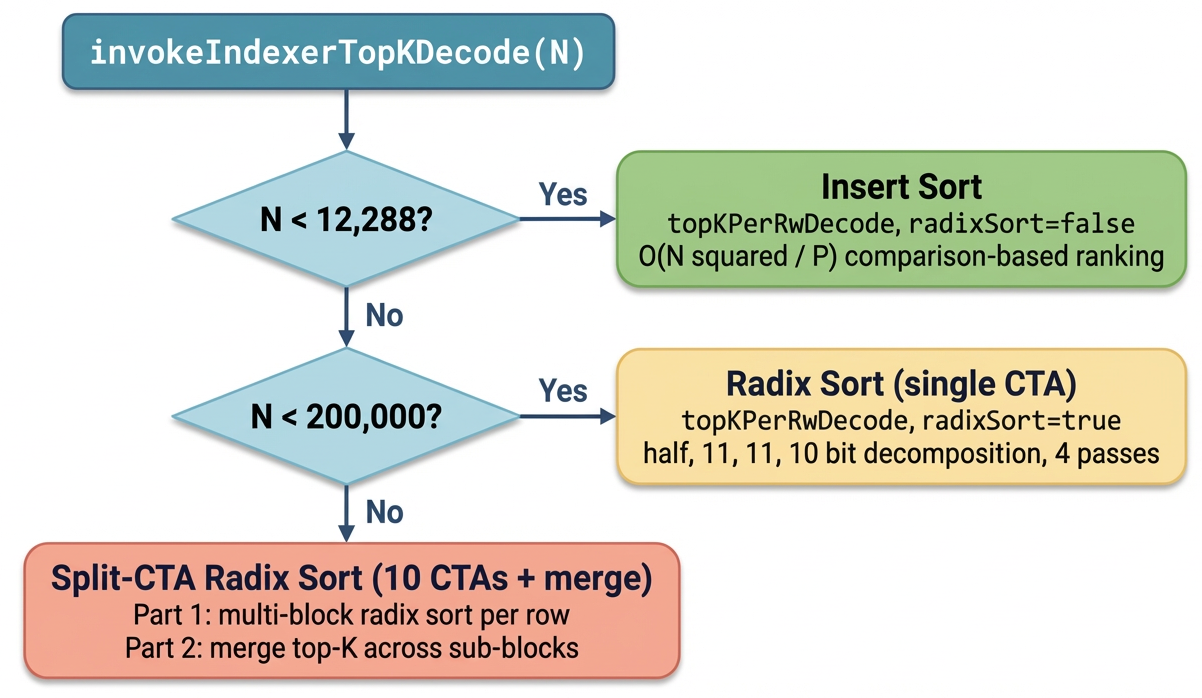
图 2: Figure 2 (extracted from PDF)
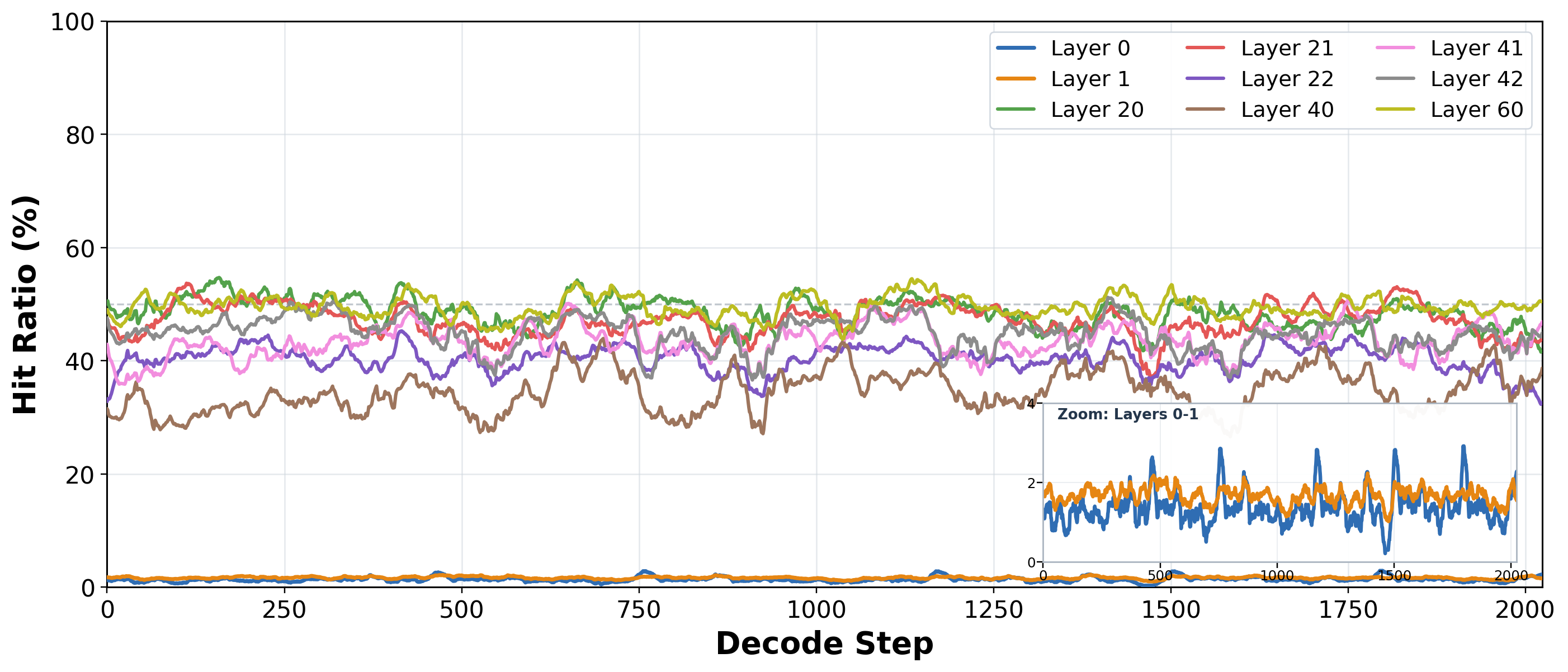
图 3: Figure 3 (extracted from PDF)
原始摘要
Sparse-attention decoders rely on exact Top-K selection to choose the most important key-value entries for each query token. In long-context LLM serving, this Top-K stage runs once per decode query and becomes a meaningful latency bottleneck even when the indexer and attention kernels are already highly optimized. We present \textbf{Guess-Verify-Refine (GVR)}, a data-aware exact Top-K algorithm for sparse-attention decoding on NVIDIA Blackwell. GVR exploits temporal correlation across consecutive decode steps: it uses the previous step’s Top-K as a prediction signal, computes pre-indexed statistics, narrows to a valid threshold by secant-style counting in 1-2 global passes, verifies candidates with a ballot-free collector, and finishes exact selection in shared memory. We connect this behavior to the Toeplitz / RoPE structure of DeepSeek Sparse Attention (DSA) indexer scores and validate the design on real DeepSeek-V3.2 workloads integrated into TensorRT-LLM. GVR achieves an average \textbf{1.88x} single-operator speedup over the production radix-select kernel, with up to \textbf{2.42x} per layer per step, while preserving bit-exact Top-K outputs. In controlled TEP8 min-latency deployment, it improves end-to-end TPOT by up to \textbf{7.52%} at 100K context, with larger gains at longer contexts and smaller but still positive gains under speculative decoding. While implemented and validated in the current TensorRT-LLM DSA stack on Blackwell, the same principle may extend to sparse-attention decoders whose decode-phase Top-K exhibits temporal stability.